
 Available in GB
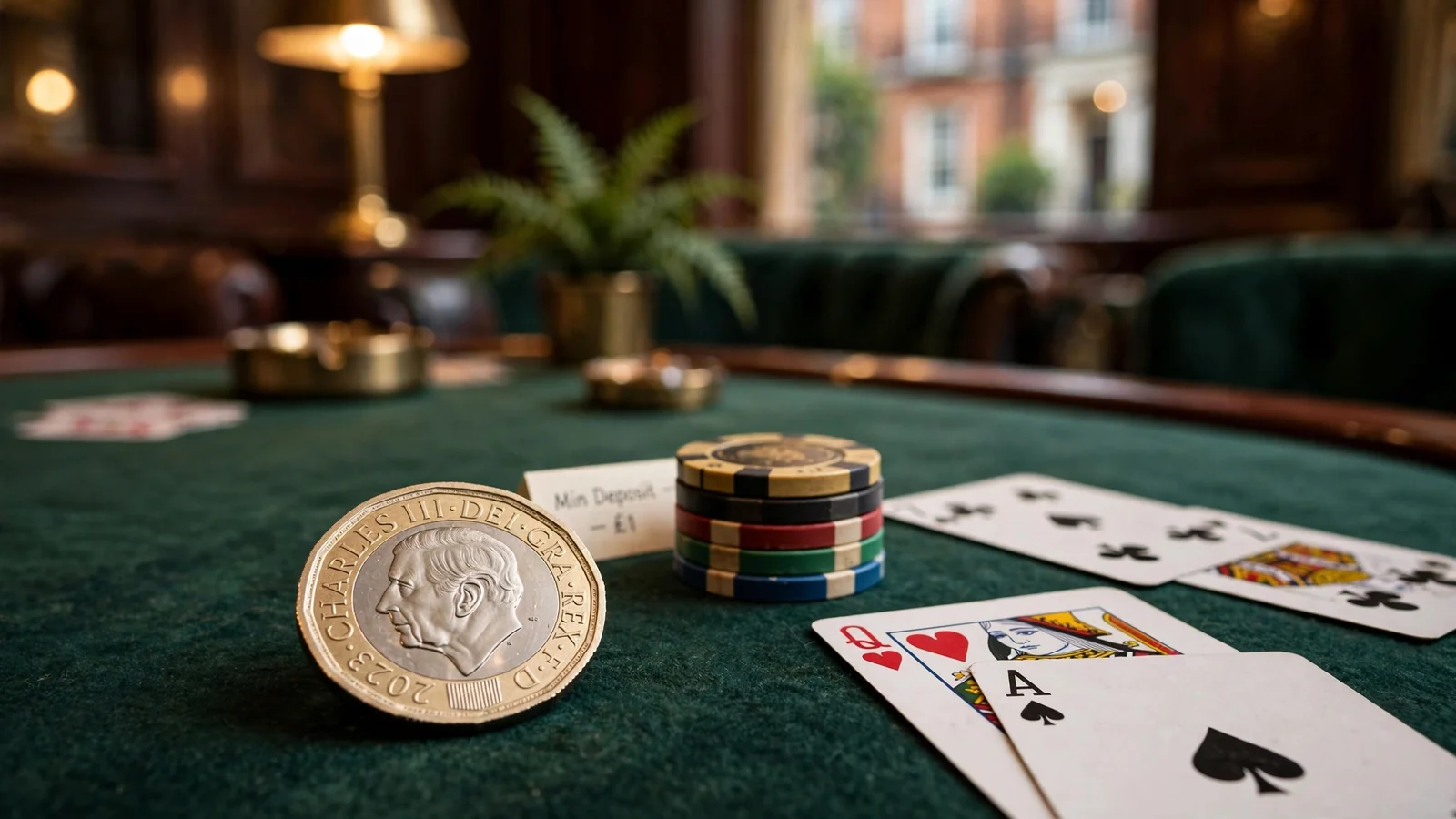
Content
- What a £1 Minimum Deposit Really Means
- How £1, £5, £10 and Higher Minimums Compare
- What Changed for Bonuses in 2026
- Which Payment Methods Can Work for a £1 Deposit
- Playing for Real Money After a Small Deposit
- £1 Slot Sites and Gamstop: Check Your Situation First
- PayPal and Other Options for Small Deposits
- Set a Spending Limit Before You Deposit
- When a £1 Deposit Is Not a £1 Withdrawal
- A Named Example of a £1 Cashier Minimum
A practical guide to checking whether £1 can fund an account and how cashier rules differ from promotion conditions.
What a £1 Minimum Deposit Really Means
A £1 minimum deposit means the casino’s cashier accepts a deposit of £1 into a real-money account. Some casinos serving the UK market do allow this, but the phrase can be used loosely in promotional wording. Before treating it as a genuine minimum, check what the cashier actually permits and whether the amount refers to funding your balance, rather than meeting a separate condition.
The distinction matters because a low advertised entry point does not necessarily mean you can make a £1 deposit and use the account on those terms. An offer may mention a small amount while setting its own eligibility rules. Or a page may describe a casino as a £1 option without confirming that the cashier accepts that amount for your account. The practical test is whether the deposit screen allows you to enter or select £1 and proceed with the payment.
A cashier minimum and an offer’s qualifying deposit are different things. The first concerns the amount you can put into your account. The second concerns whether a promotion becomes available after you deposit. A casino could accept a small deposit while applying different conditions to a welcome offer. Equally, a promotional headline should not be taken as proof that the cashier’s actual minimum is £1. Read the terms attached to the specific offer, if there is one, rather than assuming that every advertised amount describes the same thing.
It also helps to separate a genuine minimum from a suggested starting amount. A site might display a preferred deposit amount prominently, but that does not by itself establish the lowest amount it accepts. Look for the minimum stated in the cashier or in the operator’s payment information, then check that the figure applies to the account you are opening. If the information is unclear or the cashier does not accept the amount, do not rely on a headline to settle the question.
A specialist review reported six UK Gambling Commission-licensed casinos with a genuine £1 cashier minimum at the time it checked. That is a dated snapshot, not a promise that the same number of operators will retain the threshold. Casino terms and cashier settings can change, so the current information shown by the operator matters more than a past count. The useful point is that a real £1 minimum exists, while it should not be assumed to be available at every UK casino.
£2 Minimum Deposit Casinos in the UK: What to Know
The word “minimum” can also conceal a difference between what the site permits and what you intend to do. A £1 deposit gets money into the account; it does not, on its own, establish that an offer applies or settle every other account condition. Treat the deposit threshold as one narrow piece of information. Check the operator’s terms for the conditions that apply to your account, and avoid reading more into the £1 figure than it says.
For a UK player, the operator’s status is part of that basic check. Online gambling is legal in the UK only at sites holding the appropriate UK Gambling Commission licence. A site presenting itself as available to UK customers is not, by that fact alone, proof of authorisation. Confirm the operator’s current licence before opening an account or depositing. You must also be at least 18 to gamble online in the UK.
A careful check can be simple: confirm that the operator is licensed, find the cashier minimum, and make sure the displayed amount is an actual deposit option rather than wording tied to an offer. If you are unsure what a page means by “from £1”, ask the operator to clarify before paying. The answer should distinguish the cashier’s lowest accepted deposit from any promotion’s qualifying conditions.
A £1 minimum deposit is therefore a specific cashier feature, not a general promise about the whole account. It tells you that a small deposit may be accepted at that operator; it does not tell you what promotions you can claim or resolve other terms. Keeping those points separate makes it easier to judge the claim accurately and to decide whether the stated minimum suits what you want to do.
Top online casinos in the UK
- SlotoSportBonus: 500% up to £ 10 200+ 777 FS · Payout speed: 1-3 business days
- BeOnBetBonus: 100% up to €500 + 100 FS · Payout speed: 1-3 business days
- AmunbetBonus: Join now and get 450% up to 2,700 GBP + 450 FS · Payout speed: 1-3 business days
- NightWinBonus: £900 + 400 free spins · Payout speed: 1-3 business days
- WinBeastBonus: €5000 + 500 FS + €650 Freebet · Payout speed: 1-3 business days
- ChanzeBonus: Slots Welcome Bonus #1 200% up to €500 · Payout speed: 1-3 business days
- DieselwinBonus: Welcome Pack 250% up to £4000 + 200 FS · Payout speed: 1-3 business days
How £1, £5, £10 and Higher Minimums Compare
A £1 cashier minimum is the lowest entry point described for UK casinos, but it is not the threshold you should expect to find everywhere. A specialist review characterises that tier as rare and says it may be available only through particular routes, such as Boku or Payforit mobile billing. The £5, £10 and £20 levels provide a broader comparison: they show how much more you may need to deposit when an operator does not accept a pound, or when its chosen payment method has a higher minimum.
£1
An unusually low cashier minimum that is rare and may depend on the payment route.
£5
An entry point above the rare £1 tier but below the typical direct banking threshold.
£10
Identified as the typical minimum for direct banking in a specialist review.
£20
A higher threshold used by some operators for direct banking.
For direct banking, a specialist review identifies £10 as the typical minimum, while noting operators that set it at £5 or £20. Treat those figures as a snapshot of the options covered by that review, not a fixed rule for every casino. The cashier displayed by an operator is the practical point of reference: it shows whether the method you intend to use meets that account’s current threshold.
What each threshold tells you
At £1, you are looking at an unusually low cashier minimum, not a general standard. If an operator accepts that amount, the option may depend on the payment route rather than applying across every method. A site can therefore be described as allowing a £1 deposit while still presenting a higher minimum for another way of paying. Check the amount against the specific method shown in the cashier before treating it as available to you.
At £5, the threshold is above the rare £1 tier but below the £10 figure identified as typical for direct banking in the specialist review. Some operators set direct banking at this level. The difference matters when you compare sites: a £5 cashier minimum can be a genuine lower entry point, even if it is not the lowest one available.
At £10, you reach the direct-banking threshold identified as typical by that review. This is not necessarily the minimum for every payment method at every operator. Nor does the number tell you whether a casino offers the same threshold across its entire cashier. It is a comparison point, not a promise.
At £20, the minimum is higher than the other thresholds discussed here. Some operators in the review set direct banking at that amount. If you have budgeted for a smaller deposit, that difference may rule out the method or the operator for you. Do not assume the cashier will accept a lower amount simply because another casino does.
£20 Minimum Deposit Casinos in the UK: What to Know
The operator and method both matter
Within one UK operator, the minimum deposit is generally the same across payment methods. There are exceptions: some casinos set a higher minimum for direct banking than for cards or e-wallets. That means comparing only the casino’s headline figure can leave out an important detail. The relevant figure is the cashier minimum attached to the method you plan to select.
The reverse can also happen: a low threshold shown for one payment route does not establish that every other route will accept the same amount. If the cashier lists separate methods, read the amount beside each one rather than carrying the lowest figure across the whole page. This is especially important when you are comparing a £1 option with a £5, £10 or £20 threshold elsewhere.
A useful comparison is therefore not simply “Which casino has the lowest number?” It is “What is the minimum for the payment method available to me?” Two operators may display different thresholds, and one operator may show more than one threshold depending on the method. The practical difference is the amount you must commit before that particular route can be used.
Do
- Check the minimum for the specific payment method you intend to use
- Read the amount beside each method in the cashier
- Compare applicable amounts for different routes
Don’t
- Rely on a single headline figure for the whole account
- Assume the lowest figure applies to every payment method
- Infer that a smaller deposit is accepted if the minimum is unclear
Comparing options without overreading the headline
When assessing a minimum-deposit casino, keep the figures in context. A £1 threshold is a rare low tier, while £5, £10 and £20 are other points at which operators may set their cashier minimums. The specialist review’s direct-banking comparison places £10 as typical and records £5 and £20 alternatives; it does not mean every casino fits neatly into one of those amounts.
Check whether the stated figure applies to the whole account or only to a particular payment method. If the cashier presents a higher minimum for direct banking than for a card or e-wallet, compare the applicable amounts rather than relying on a single headline. If the minimum is unclear, do not infer that a smaller deposit will be accepted.
This gives you a more accurate way to compare the lowest available entry point with the more common thresholds. The £1 tier is distinctive because it is rare and may be method-specific; the £5, £10 and £20 levels show how the required amount can rise between operators or payment routes. A clear comparison starts with the cashier minimum for the method you can use, not just the smallest number attached to a casino.
What Changed for Bonuses in 2026
The important change for casino bonuses is the wagering cap introduced on 19 January 2026. Since that date, UK Gambling Commission rules have prevented gambling incentives from requiring wagering of more than 10 times the bonus funds. This sets a ceiling on the qualifying play attached to an incentive; it does not mean every offer has the same conditions, or that every deposit earns a bonus.
£3 Minimum Deposit Casinos in the UK: What to Check
That distinction matters if you are considering a £1 minimum deposit casino. A cashier may accept £1 while the welcome offer has a separate qualifying-deposit threshold. A specialist review reports welcome offers requiring deposits of £5 to £10, so a £1 payment may add funds to your account without activating a promotion. Treat that range as reported offer information, not a rule that applies to every casino. The offer’s own terms determine whether your deposit qualifies.
The cap limits wagering, not eligibility
Wagering requirements describe how much qualifying play is required before bonus funds, or winnings connected with them, can be converted into withdrawable cash. The 10x limit constrains that requirement for bonus funds. It does not remove other conditions that may decide whether you can claim an offer in the first place.
For instance, the minimum qualifying deposit can be higher than the cashier minimum. An offer may also have its own claim process or eligibility wording. A small deposit therefore cannot be assumed to trigger a welcome promotion simply because the account accepts the payment. Before opting into an offer, look for the qualifying deposit amount and check that your intended deposit meets it.
Also read which part of the offer the wagering requirement applies to. The cap concerns wagering attached to bonus funds; it is not a promise that a particular bonus will be credited, nor does it guarantee a cash return. The operator’s terms should explain the offer’s requirements and how the bonus is handled.
What to check before accepting
Read the promotion terms before you claim, rather than relying on a banner or headline. Confirm the minimum qualifying deposit, whether the offer needs to be selected or claimed, and how the wagering condition is described. If the wording is unclear about whether a £1 deposit qualifies, ask the operator before accepting the promotion. That can help you avoid assuming that the cashier threshold and the offer threshold are interchangeable.
Attention A £1 deposit may be enough to fund an account, but it may fall short of a welcome offer’s qualifying deposit amount.
Check whether the terms distinguish between cash in your account and bonus funds. A deposit can be accepted without an incentive being added, while accepting an incentive may place conditions on the bonus and associated winnings. Make sure you understand what must be completed before any promotional balance can be withdrawn. The 10x ceiling does not answer those eligibility questions by itself.
Do not treat an advertised offer as available to every new customer. The qualifying deposit and other conditions in the current terms are what matter for your account. If the terms state a higher entry amount than the £1 you plan to deposit, the offer is not made eligible merely because the casino’s cashier accepts £1.
A practical way to assess a £1 offer
When comparing a £1 minimum deposit casino in the UK, separate three points: whether the cashier accepts the amount, whether the promotion accepts it as a qualifying deposit, and what wagering applies if the offer is credited. These are related, but they are not the same condition. A low cashier minimum answers only the first point.
Since 19 January 2026, the wagering requirement for bonus funds cannot exceed 10x. If an offer’s stated bonus wagering condition appears higher, do not assume it overrides the cap; seek clarification from the operator before claiming it. If the requirement is within the cap, still check the deposit threshold and the rest of the terms. A compliant wagering limit does not automatically make a £1 deposit eligible.
£4 Minimum Deposit Casinos in the UK: What to Check
The safest reading is straightforward: a £1 deposit may be enough to fund an account, but it may fall short of a welcome offer’s qualifying amount. The 2026 cap limits how much wagering can be required on bonus funds; it does not turn every low cashier minimum into a promotional entry point.
Which Payment Methods Can Work for a £1 Deposit
A £1 payment depends on more than the amount shown beside a casino’s cashier. The payment route must be available to you, accepted by the operator and permitted at that transaction size. Visa and Mastercard debit cards are accepted by almost all UK casinos and can support low deposits, but that does not mean every cashier will process a £1 payment by card. Check the minimum shown for the specific method before confirming.
The distinction matters because a casino may accept a £1 deposit through one route but set a higher cashier minimum for another. The amount you can send may also be affected by the payment provider’s own rules. If the cashier offers several options, read the displayed terms for each rather than assuming that a minimum applying to one method carries across the others.
Debit cards
A debit card is a straightforward route to consider for a small deposit. The Gambling Commission’s ban on credit-card gambling took effect in 2020, so a gambling deposit must not be funded by credit. Use a debit card linked to your bank account, not a credit card, even if the card brand is the same.
Credit Card Ban
Gambling deposits in the UK must not be funded by credit cards; use only debit cards linked to your bank account.
The cashier should identify whether it accepts Visa or Mastercard and show the minimum for that method. If £1 falls below the displayed limit, do not try to work around it by splitting a payment or using another person’s card. Choose only a method the operator permits and that you are entitled to use. The operator must verify your age before letting you deposit, and UK gambling accounts are for adults aged 18 or over.
A low minimum on the card route can be useful when you want to keep the transaction small, but it does not remove the need to check what the payment will cost. A specialist review has reported flat transaction fees of £1 to £3 for some payment providers. Treat that as a possible charge to check, not as a standard fee applying to every card or casino. If a fee is added to a £1 transaction, it could be as large as, or larger than, the amount you intended to deposit. Look for any fee notice in the cashier and in the provider’s own terms before proceeding.
E-wallets
Some e-wallets may also handle a small payment, but eligibility depends on how the wallet is funded and on the rules applied by the casino and payment service. For UK gambling, the wallet must be funded by debit rather than credit. A wallet that allows credit-card funds to be used for gambling is not an acceptable route for a casino deposit.
Before choosing an e-wallet, check both sides of the transaction: whether the casino accepts it and what funding sources the wallet permits. A payment button appearing in the cashier does not, by itself, tell you whether every balance in that wallet is suitable for gambling. If you are unsure how the balance was funded, use a permitted debit or bank-account route instead.
No minimum deposit casinos in the UK: £1 explained
A wallet may also apply its own transaction conditions, separate from the casino’s cashier minimum. Read the amount and any charge shown before authorising the payment. Do not assume that because an account can hold a small balance, a casino will accept a deposit of the same size.
Direct banking
Direct banking uses a bank account rather than a credit card. It is among the permitted ways to fund a UK gambling account, provided the payment is made from your own eligible account and the casino offers that route. A casino may display different conditions for direct banking than for a debit card or e-wallet, so check the cashier rather than relying on the minimum listed beside another method.
Banking options can also involve a payment journey outside the casino’s own page. Confirm the recipient and amount before approving the transaction, and make sure the final screen still shows the deposit you intended. If the payment flow displays a fee or a minimum higher than £1, pause rather than completing it on the assumption that the casino will adjust the amount afterwards.
Check the payment before you confirm
For an online casino with a £1 minimum deposit, the useful question is not simply whether the operator accepts small deposits. Check which payment method supports that amount, whether the method is available to you, and whether any provider charge changes the total leaving your account. The casino’s cashier is the place to confirm the amount currently accepted for each route; payment terms can differ between methods at the same operator.
Deposit Verification
- Confirm the operator holds a UK Gambling Commission licence
- Verify the minimum deposit for your chosen payment method
- Check for any transaction fees from the payment provider
- Set a financial spending limit before depositing
Use only a debit card, an e-wallet funded by debit, or a bank account for gambling deposits. Credit cards are not permitted, including where credit-card funds are routed through a money service business. Once you have selected an eligible route, review the amount and any fee on the final confirmation screen. Set a financial limit before making your first deposit, and do not proceed if the payment details do not match what you intended.
Playing for Real Money After a Small Deposit
A £1 deposit gives you a small real-money balance, not a fixed amount of play. What it can cover depends on the stake you choose and the result of each spin. Many slots accept bets of £0.10 to £0.20 per spin, so even a modest run of losing spins can use up a £1 balance. A win may extend your play, but it is not something you can rely on.
Check the stake shown in the game before you start. Slot controls can offer several bet sizes, and the amount selected may not be the lowest available. This matters on a mobile casino too: the smaller screen does not change the cost of a spin, so make sure you can see the stake and balance clearly before playing.
A small balance can also be difficult to turn into a cash-out. The cashier’s minimum withdrawal is separate from the amount you can deposit. A specialist casino review reported withdrawal thresholds of £10 to £20 at some UK casinos; that is a reported range, not a rule that applies to every operator. A separate specialist review described minimum withdrawals from £1 to £5 at some casinos. These differing figures underline why the cashier terms for the specific site matter.
Online Casinos With No Sister Sites in the UK
If the withdrawal threshold is higher than your balance, you may not be able to request a payout yet. That does not mean you should keep playing to reach it: further play can reduce the balance, and there is no guaranteed route from a £1 deposit to a withdrawal. Check the minimum cash-out amount and any conditions attached to a withdrawal before deciding whether to play.
The deposit and withdrawal rules can also differ by payment method. A debit card or some e-wallets may accept a £1 transaction, while the operator’s cash-out terms set a separate minimum. Do not assume that because a payment route allowed a small deposit, it will return the same amount in a withdrawal.
For real-money play, treat the balance as money that can be lost, rather than as a promise of a certain number of spins or a payout. Before starting, look at the game’s stake control and the casino’s withdrawal terms. That gives you a clearer picture of what the balance can do and whether a future cash-out would be available under the operator’s rules.
£1 Slot Sites and Gamstop: Check Your Situation First
A £1 minimum deposit and GamStop status are separate matters. A casino may accept a small deposit, but that does not tell you whether it participates in GamStop or whether it is suitable for you. Treat descriptions such as “not on GamStop” as a reason to pause and check the operator’s legal status, not as a feature that makes a site a better choice.
GamStop is a self-exclusion service. If you have registered with it, looking for a casino outside the scheme can undermine the barrier you chose to put in place. Do not treat an operator’s claim about its status as a reason to gamble while self-excluded. If you are unsure what your registration means for you, contact GamStop directly rather than trying to work around it.
Online gambling is legal in the UK only at sites holding the appropriate UK Gambling Commission licence, regardless of where the business is based.
In the UK, online gambling is legal only with operators that hold the relevant UK Gambling Commission licence. This applies to operators selling gambling to customers in Great Britain, even if the business is based elsewhere. A casino operating offshore without a UKGC licence is outside the UK regulatory system; a low cashier minimum does not change that. Check the operator’s current licence details with the Commission before opening an account.
You must be at least 18 to gamble online in the UK. Age eligibility and a small deposit do not replace the need to check that the operator is licensed and that you are comfortable with the decision to play.
If you are considering £1 slot sites, focus first on whether the site is legally available to UK players and whether using it fits your circumstances. Do not rely on labels such as “casino not on GamStop” to establish either point. If you have self-excluded or are trying to avoid gambling, stepping away from the deposit page is safer than searching for another route.
PayPal and Other Options for Small Deposits
Seeing PayPal in a casino cashier does not confirm that it will process a £1 deposit. The payment option may be available while the operator sets a higher cashier minimum, or while PayPal’s own transaction rules prevent a payment at that amount. Check the amount shown after selecting PayPal, rather than relying on a general claim that a casino accepts small deposits.
The operator’s minimum is often shared across payment methods, but it is not guaranteed to be. Some casinos set a higher threshold for direct banking than for cards or e-wallets. That means a £1 option shown for one route may not apply to PayPal, and a figure advertised on a casino page may not match the amount offered in your account’s cashier.
Anjouan Casino Licence in the UK: What It Means
A specialist review has reported that some e-wallets, alongside debit cards, can handle £1 transactions. That does not establish that PayPal will do so at every UK casino. Treat the cashier’s current terms as decisive: check the minimum beside the chosen method and whether any transaction fee would make a very small payment poor value.
There is also an important funding restriction. A UK-licensed casino cannot accept a gambling payment funded by a credit card, including through a wallet or money service. Use PayPal only where the funds come from a permitted source, such as a debit card or bank account, and check that the wallet arrangement does not allow credit-card funds to be used for gambling.
If PayPal will not accept the small amount you intended to deposit, do not assume that switching methods will automatically solve it. The operator may apply the same minimum across its cashier, or a different threshold to a particular route. Compare the amount displayed for each available option before confirming payment; the label “PayPal accepted” alone does not tell you what the smallest payable amount is.
Set a Spending Limit Before You Deposit
Before you fund an account, decide what you can afford to lose and set that amount as your spending limit. Treat it as money spent, not as a balance you expect to win back. A small cashier minimum can make a first deposit feel insignificant, but it does not tell you whether further deposits will fit your budget.
Use the mandatory financial limit prompt during registration to establish a clear budget before you start playing.
UK-licensed casinos must prompt new customers to set a financial limit before their first deposit. Use that step rather than dismissing it, and look for the account controls that let you manage your limit afterwards. Make sure you know where those controls are before you start playing; it is harder to make a calm decision once you are focused on a game or trying to recover a loss.
Choose a limit that reflects your own finances, not the amount a casino allows you to deposit. If your budget is already under pressure, do not use gambling to try to improve it. A limit is a practical boundary, not a target to reach or a reason to deposit more.
Keep track of deposits as well as time spent playing. If you reach the amount you set, stop rather than raising the limit in the moment. The purpose is to make the decision in advance, while you can consider it clearly. Account-level limit controls should be easy to find, so check the relevant account settings before depositing and make sure you understand how to use them.
When a £1 Deposit Is Not a £1 Withdrawal
A £1 cashier minimum tells you how little you can pay into an account; it does not promise that you can later cash out £1. Depositing and withdrawing are separate transactions, and the operator may set a higher minimum for withdrawals than for deposits.
That difference matters if you decide not to continue playing or your balance remains small. If the amount available to withdraw is below the casino’s cash-out threshold, you may have to leave it in the account until the balance meets the stated minimum. The threshold and any other withdrawal conditions should be checked in the operator’s terms before you deposit, rather than assumed to match the cashier minimum.
A specialist review reported withdrawal thresholds of £10 to £20 at many UK casinos. Treat that as a report about the operators it reviewed, not a rule that applies across the market. The amount can depend on the casino, so check the specific account’s withdrawal terms.
Also distinguish the minimum cash-out amount from the balance you can withdraw. A displayed threshold explains when a withdrawal request may be accepted; it does not, by itself, tell you what other conditions apply. Read the full withdrawal section and look for any stated limits or requirements before making a decision.
If your priority is being able to withdraw a small balance, do not rely on a £1 deposit label. Confirm the withdrawal minimum directly in the casino’s current terms. A low amount accepted at deposit can still leave you unable to request a payout until you meet a separate threshold.
A Named Example of a £1 Cashier Minimum
NetBet is a named example of a UK casino reported to accept a £1 deposit through its cashier. A specialist casino review identified it as the only UKGC-listed casino in the set it assessed with that stated minimum. This is a specific reported finding, not a claim that NetBet is the only UK operator that may offer a £1 entry point.
The distinction matters when you check the cashier. A general reference to a small starting amount does not, by itself, confirm that the minimum applies to every payment route or remains available when you deposit. Look at the amount shown for your selected method before confirming, and make sure the account is with an operator holding the relevant UK Gambling Commission licence.
Treat the named example as a point to verify, rather than as a recommendation. Cashier details can change, so the figure in the live deposit screen and the operator’s current terms are more useful than an older review. If the cashier presents a higher minimum, do not assume that another route will accept £1; check its stated terms first.
A £1 cashier minimum tells you the smallest deposit the operator says it will accept under the applicable conditions. It does not establish that every customer will see that threshold or that the same amount can later be withdrawn. Check the relevant account and cashier information before deciding whether to proceed.
Which payment method is best for low-deposit casino players?
Visa and Mastercard debit cards are accepted at almost all UK casinos and support low minimum deposits. Some e-wallets also allow £1 transactions, so check the cashier’s minimum for your chosen method.
Do direct banking deposits qualify for welcome bonuses at UK-licensed casinos?
Yes, direct banking deposits qualify on the same basis as card or e-wallet deposits. The bonus terms do not change according to the payment method.
Are there no minimum deposit casinos?
No deposit is required only if you do not fund the account; casinos that accept deposits still set a minimum. Some UK casinos accept as little as £1.
Which payment methods usually accept £1 deposits?
Debit cards and some e-wallets can support £1 deposits. Boku and Payforit mobile billing may also offer a £1 minimum; check the cashier because limits can differ by payment method.